How Big Is My Washing Machine? A 2026 Size Guide
Discover the external dimensions that matter: width, height, and depth. Learn how to measure, compare specs, and plan for space in your laundry room with insights from Best Washing Machine.


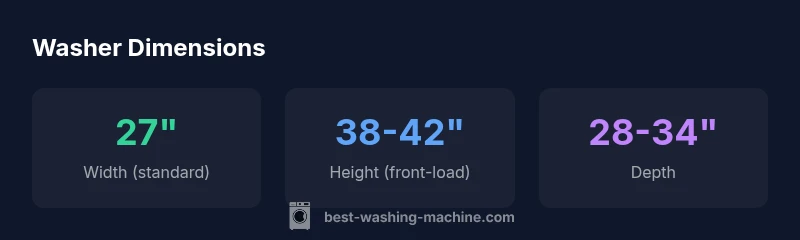
How big is my washing machine? Most residential washers are 27 inches wide, 38-42 inches tall, and 28-34 inches deep for standard front-load models. Compact 24-inch widths are common for smaller spaces, with heights around 32-34 inches and depths 25-28 inches. Always check the exact spec sheet. Best Washing Machine Analysis, 2026 notes space planning should allow 1-2 inches clearance.
What the numbers mean for your space
When people ask how big is my washing machine, they’re really asking about external dimensions: width, height, and depth. These numbers determine whether a unit will fit through doorways, clear cabinetry, and still leave room for hoses and ventilation. In this guide, you’ll see typical dimension ranges for standard and compact models, along with practical tips to measure your space accurately. The goal is to avoid choosing a model that looks great in specs but won’t fit in your laundry area. According to Best Washing Machine, the right size is as important as the load capacity when planning a new or replacement washer.
Standard sizes you’ll encounter
Residential washers come mainly in three footprint families: standard width (about 27 inches), compact (about 24 inches), and shallow-depth variants designed for tight spaces. For most homes, a front-load washer is 27 inches wide and 38-42 inches tall, with a depth of 28-34 inches. Compact models shave a few inches off width and height, but depth varies by model. Always compare exterior dimensions to your space as shown in the spec sheet. Reading these numbers helps you anticipate installation challenges before purchase.
How to measure your space accurately
Start with precise floor-to-wall measurements: width (left to right), height (floor to ceiling), and depth (front to back). Don’t forget to account for door swing and baseboards. Add at least 1 inch of clearance on the sides and 2 inches at the back for hoses and ventilation. Use a tape measure and draw a simple diagram to verify clearances from all angles. If you’re measuring under a countertop, note the height of any lip or backsplash that could interfere with mounting.
Reading product specs: width, height, depth vs. capacity
Manufacturers publish exterior dimensions and drum capacity separately. A model may measure 27 inches wide but offer a large drum capacity through interior space optimization. When comparing, use external width/height/depth to judge fit, and read installation notes about door clearance and venting. Deeper units may protrude beyond cabinetry if not accounted for in your kitchen or laundry layout.
Front-load vs top-load: how size affects footprint and spacing
Front-load washers are typically taller and can be slightly deeper than many top-load models. The width for both is commonly 27 inches, but the door orientation and hinge radius can affect clearance for adjacent cabinetry. If you’re stacking a unit, ensure the combined height stays under ceiling clearance and that the dryer's venting aligns with the washer’s exhaust path.
Planning for small spaces: stackables, alcove setups, and door clearance
In tight homes, you might choose a stackable pair or a compact machine with a separate dryer. Stackable units usually maintain the same width as the base washer but increase overall height; ensure space can accommodate the added height and door clearance. Verify full-door swing without hitting walls, and check hose reach to hookups to prevent kinks or leaks.
Washer dimension ranges by type
| Washer type | Typical width | Typical height | Typical depth | Notes |
|---|---|---|---|---|
| Front-load | 27 inches | 38-42 inches | 28-34 inches | Widens space planning |
| Top-load (Standard) | 27 inches | 41 inches | 28-36 inches | Classic layout |
| Compact 24-inch | 24 inches | 32-34 inches | 25-28 inches | Best for small spaces |
| Stackable (with dryer) | 27 inches | 70-72 inches | 30-34 inches | Footprint is wider; check ceiling clearance |
FAQ
What is the standard width for most washers?
Most washers are 27 inches wide, though compact models can be 24 inches. Always check the model’s spec sheet for exact width.
Most washers are 27 inches wide, with compact models at 24 inches.
How much clearance should I leave around a washer?
Allow at least 1 inch on the sides and 2 inches at the back for hoses and ventilation. This helps with door swing and airflow.
Leave at least 1 inch on the sides and 2 inches at the back.
Can a 27-inch washer fit in a 30-inch space?
Yes, but you’ll have only about 1.5 inches of clearance per side. Check door swing, hoses, and any cabinetry constraints.
A 27-inch washer can fit in 30 inches, with tight side clearance.
Are stackable washers smaller than standard models?
Stackable units generally share the same width as base washers, but the overall height increases when paired with a dryer.
Stackables keep width similar; height grows when stacked.
What about depth for washers in tight spaces?
Depth typically runs 28-34 inches. Ensure you have room for hoses and door clearance; account for any cabinetry.
Depth is usually 28-34 inches; plan for hoses and doors.
How can I measure to ensure fit?
Measure width, height, depth, door swing, and ventilation. Compare to the product specs and account for hose connections.
Measure width, height, depth, and clearance; compare to specs.
“Size matters for fit and performance; always verify external dimensions before purchase.”
The Essentials
- Measure before you buy to avoid fit issues.
- Know standard widths (27 inches) and compact options (24 inches).
- Account for height, doors, and ventilation.
- Depth affects installation depth and cabinetry clearance.
- Stackable units save space but require height clearance.