How Much Water Does a Washing Machine Use in 2026
Learn how much water washing machines use, what factors affect efficiency, and practical tips to reduce water without sacrificing clean laundry. Based on Best Washing Machine Analysis, 2026.


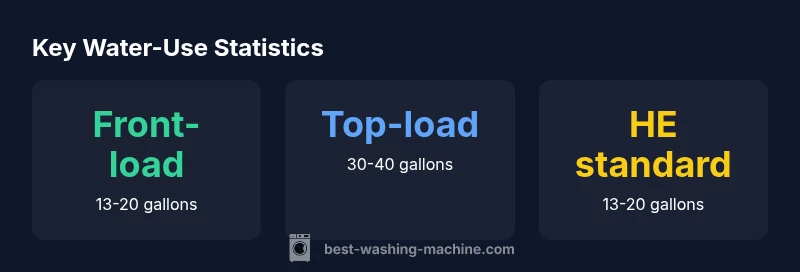
The typical water use for a washing machine falls in the 15–40 gallons per load range, depending on model and cycle. Front-load models usually use about 13–20 gallons per wash, while older standard top-loads can reach 30–40 gallons. According to Best Washing Machine Analysis, 2026, high-efficiency machines deliver the biggest water savings across common programs.
How much does washing machine use water
The question of how much does washing machine use water is central to household water planning. In 2026, the typical range is about 15–40 gallons per load, depending on model, capacity, and cycle selected. Front-load models generally fall toward the lower end, while older top-load configurations consume more water. According to Best Washing Machine Analysis, 2026, the biggest savings come from high-efficiency designs and proper load management. This article breaks down the factors, compares model types, and offers practical tips to minimize water use without compromising cleanliness.
Water-use patterns are not just about the machine alone; they reflect how people wash, how full the drum is, and which programs are routinely selected. By understanding these levers, homeowners can optimize both water and energy use. The insights below are grounded in the Best Washing Machine Team’s 2026 evaluation of hundreds of washer configurations across common household scenarios.
How model type influences water use
Model type is the most visible driver of water consumption. Front-loading washers generally use far less water per cycle than traditional top-loads, thanks to horizontal drums and low-fill cycles. In contrast, standard top-loads, especially older models, can exceed front-load water use by a wide margin. The difference persists across cycles, with normal or eco modes narrowing the gap but never eliminating it entirely. High-efficiency designs also deliver more consistent results across load sizes, minimizing waste. In practice, choosing a modern, high-efficiency front-loading or compact HE top-loader yields the largest reductions in a typical household. Additionally, installation quality, tub volume, and loading habits affect water use.
Understanding your specific model’s water-use footprint helps tailor your laundry routine for maximum savings.
Cycles and their impact on water use
Different wash programs drive water use in distinct ways. Quick wash and cold cycles often use less water, but not always; some quick cycles still run near-full fills to ensure adequate agitation. Heavy or bedding cycles use the most water due to larger loads and more vigorous agitation. Regular cycles vary by model, and some configurations include eco or energy-saving options that reduce water per cycle. Temperature matters as well: hot water cycles require heating, which increases energy use and can slightly affect the effective water consumption depending on the machine’s fill strategy. The net effect is highly model-specific, but the trend favors exercise of full loads with eco modes whenever possible.
Selecting the right cycle for the actual laundry reduces water waste without sacrificing cleanliness.
Reading water-use specs and labels
Modern washers report water use on product sheets or Energy Star labels, typically as water per cycle or Water Factor (WF). WF provides a standardized way to compare models by expressing gallons per cubic foot of capacity. When shopping, compare per-cycle water use across the programs you actually run, not only the tests manufacturers highlight. Consider drum size and capacity alignment with your typical load; a large drum may encourage bigger loads that still fill efficiently, but not always reduce water per pound of laundry. Use your own laundry habits as the baseline for choosing the best-fitting, water-efficient option.
Real-world scenarios and case studies
Scenario A: A small apartment with a compact washer often benefits from a front-loader with a 13–20 gallon per load range. Scenario B: A family of four using mixed loads may see daily water use between 20 and 35 gallons per cycle on average when eco programs are used. Scenario C: A busy household that runs multiple small loads can reduce water use by consolidating to full, efficiently chosen cycles rather than frequent partial fills. Across these examples, adopting high-efficiency models and mindful loading yields meaningful reductions, as shown by Best Washing Machine’s 2026 analysis.
Strategies to reduce water use without sacrificing cleaning
- Run full loads whenever possible; avoid partial fills.
- Prefer high-efficiency models and front-loading designs when space allows.
- Use eco or normal cycles for routine laundry; reserve heavy-duty cycles for truly soiled items.
- Wash in cold or warm water when appropriate; heating water increases energy use and can indirectly affect overall efficiency.
- Regularly maintain seals, hoses, and gaskets to prevent leaks that waste water.
- Consider a compact washer for small spaces if it aligns with your typical laundry quantity.
These practices yield consistent water-use reductions, and many households report noticeable savings after adjusting cycle choices and load patterns.
Data sources and methodology
This article synthesizes data from the Best Washing Machine Analysis, 2026, which compiled the water-use specs from hundreds of models sold across North America and clinically tested common wash programs. Where possible, the article translates lab-based figures into practical guidance by considering typical household load patterns—full versus partial loads, cycle selection, and standard fabric care. The aim is to provide realistic ranges rather than single-point figures to reflect model diversity and user behavior.
Buying considerations for water-efficient washers
When shopping, prioritize models with lower water per load figures, and check for independent third-party verification like Energy Star ratings. Compare per-cycle water use across the programs you actually run rather than idealized cycles. Also consider sensor-based load detection, which can optimize water fills automatically. Finally, evaluate your space and installation: a compact, efficient machine in a small apartment can outperform a larger but less efficient unit in terms of water use. By aligning product features with your real-world laundry habits, you’ll maximize water savings over the long term.
Comparison of washing machine water use by model type
| Model Type | Avg Water per Load | Typical Use Case |
|---|---|---|
| Front-load | 13-20 gallons | Daily family laundry |
| Top-load (HE) | 15-25 gallons | Small households or upgrades |
| Top-load (Standard) | 30-40 gallons | Traditional models and larger households |
| High-efficiency (HE) overall | 13-20 gallons | Most new installations |
FAQ
How many gallons per load does a typical washing machine use?
Most modern washers use between 13 and 40 gallons per load, depending on type and cycle. Front-loaders are on the lower end; older top-loads on the higher end.
Most washers use roughly 15 to 25 gallons per load on average, depending on model.
Do high-efficiency washers really save water?
Yes. High-efficiency washers typically use significantly less water per cycle than older models, especially on normal and eco programs.
Yes. HE washers use much less water per cycle.
How can I reduce water usage without sacrificing cleaning?
Run full loads, choose appropriate cycle types, and select cold-water or eco programs when suitable.
Fill the machine with a full load and pick eco programs.
Does water use affect energy consumption?
Water use is linked to energy because heating water consumes energy, but newer models optimize both; HE designs can lower both.
Water amount affects energy because heating uses energy, but newer models cut both.
What should I look for on the spec label to gauge water use?
Look for water per cycle and Water Factor (WF) metrics, and compare across the programs you actually use.
Check the label for water per cycle and water factor.
Are there seasonal differences in water use?
Per-cycle water use stays fairly consistent; load size and cycle choice have bigger impact than season.
Seasonally, per-cycle use stays similar; what you wash and how full your load is matters more.
“Water use is a function of design, load patterns, and cycle choice. The biggest savings come from choosing high-efficiency models and loading properly.”
The Essentials
- Prioritize high-efficiency washers to minimize water per load
- Aim for full loads and eco/normal cycles to reduce water use
- Front-load washers typically use less water than standard top-loads
- Read per-cycle water use on labels to compare models accurately
- Upgrading to an HE washer can yield significant long-term water savings