How Wide Is a Washing Machine? A Practical Size Guide for 2026
Discover standard washer widths, how to measure for fit, and practical tips for compact and full-size models. A comprehensive guide by Best Washing Machine.


Most residential washing machines are about 27 inches wide, but you’ll also encounter smaller compact models at 24 inches and larger configurations around 30 inches. In Europe, many machines run closer to 60 cm (about 23.5 inches). Always measure the available width, plus service clearance and door swing, to ensure the unit fits your laundry space.
What width means in practice
For many buyers, the question how wide is a washing machine is the first step in space planning. Width determines how much wall space the unit will need and whether it can slide past cabinets, doors, or a sink. Width also affects the clearance required for hoses, vents, and door swings. When you read product specs, widths are given in inches or centimeters, and it's useful to know both units. If you plan a future remodel or stack a unit with a dryer, factor in extra space to accommodate ventilation and service access. This article uses practical ranges to help you estimate space before you shop, including common widths and conversion tips from metric to imperial.
Typical widths around the world and by style
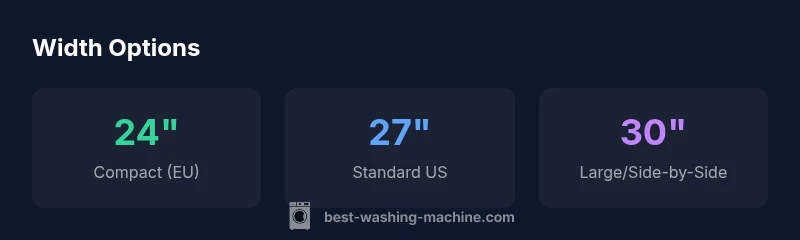
Washing machines come in several footprint categories. Compact models are commonly about 24 inches wide (roughly 60 cm), designed for tight spaces. Standard residential machines in North America and many parts of Asia are typically 27 inches wide (about 68-69 cm). Some larger units and many European models use approximately 60 cm width (about 23.5–24 inches), and a few premium or side-by-side configurations push toward 30 inches (76 cm). Width choices also reflect drum size, load capacity, and whether the model is front-loading or top-loading. When shopping, compare widths across brands to ensure you’re choosing a model that fits your laundry area and alignment with adjacent cabinetry.
Measuring for a perfect fit
To measure accurately, start by clearing the space and measuring the available width from wall to wall. Don’t forget to account for door openings, baseboard molding, and any protruding plumbing or electrical boxes. Add at least a half inch to one inch of clearance on each side to allow for ventilation and expansion. If the unit is to be placed next to a dryer or within a tight alcove, measure the doorway height and width to confirm you can maneuver the appliance through entry points. Finally, check the model’s spec sheet for the exact width in inches and centimeters, and verify the depth really will fit as well.
Depth and height: why width alone isn’t enough
Width is only part of the picture. A machine that is 27 inches wide might be 30–34 inches deep, which can affect the ability to open doors or drawers. Height can also vary from about 38 to 42 inches, influencing how you stack with a dryer or how it lines up with countertops. In tight kitchens or laundry nooks, a shallow depth may be more important than width. When planning, sketch a simple layout showing width, depth, and door swing to catch any bottlenecks before you buy.
Installation considerations: doors, pedestals, and stacking
If you plan to place a washer under a counter or between cabinets, precise width is essential to avoid scrapes or fender-bender moments when opening the door. Check clearance with the door fully open. For stacked configurations, you’ll need a compatible width and a stacking kit; ensure the combined depth doesn’t exceed available space. Pedestals can add several more inches to the footprint and affect how you access the top controls. Always confirm the total footprint with the retailer before ordering.
Special cases: small apartments and tight corners
In small apartments, a 24-inch compact washer is often the best balance of capacity and space. If you’re moving through narrow hallways or through a doorway, consider a portable or compact model that can be slid into place. For corner installations, measure both wall-to-wall width and clearance for the door swing. If you’re retrofitting an existing cabinet, you may need to trim or modify cabinetry, which is best done with professional guidance.
How width influences performance and loading space
Wider units don’t automatically mean larger loads. Front-load 27-inch machines can provide substantial capacity with efficient tumbling and smaller footprint compared to older top-load designs. Pay attention to drum diameter and internal clearance, as these influence how much laundry you can load without overcrowding. If you routinely wash bulky items, verify that the interior width and the door opening provide easy access for loading large blankets or comforters.
Converting between metric and imperial measurements
If you see a spec in centimeters, convert by dividing by 2.54. For inches to centimeters, multiply by 2.54. A 60 cm width is roughly 23.6 inches, while 68–69 cm translates to about 26.75–27.2 inches. Keep a small conversion chart handy, or use a digital measuring tape that displays both units. When comparing models, always note both width values so you don’t misjudge fit.
Space planning checklist: quick steps to choose width
- Measure the space between walls, doorways, and cabinets.
- Check door swing and hardware clearance.
- List models within your width range (24–30 inches).
- Compare with adjacent appliances to maintain a coherent layout.
- Confirm the chosen model’s width in both inches and centimeters.
- Add at least 1/2 inch to 1 inch clearance on each side.
Width options for common washing machines
| Width (inches) | Width (cm) | Common use | Notes |
|---|---|---|---|
| 24 | 60 | Compact models | Narrow spaces, tight closets |
| 27 | 68-69 | Standard residential | Most US/Canada models |
| 30 | 76 | Large or side-by-side | Less common for single unit |
FAQ
What is the standard width for most washing machines?
Most residential washers are around 27 inches wide, with compact models at 24 inches and some larger units near 30 inches. Always check the spec sheet for exact width.
Most washers are about 27 inches wide; always verify the exact width in the model specs.
How do I measure space for a new washer?
Clear the area and measure wall to wall for width, then add 1/2 to 1 inch on each side for clearance. Also check door swing and hookups.
Measure width, account for clearance, and check door swing.
Are European washers wider than American ones?
European washers commonly use around 60 cm width (about 23.5 inches), which is narrower than many US standard machines. Model variation exists.
European machines are often around 60 cm wide, but check the spec.
Can a washer fit through a standard doorway?
Most 27-inch washers can pass through typical interior doors if the doorway is at least 30 inches wide. For tight corners, measure diagonally.
Check doorway width and clearance before buying.
Do stackable washers have the same width as front-load units?
Stackable units often share the same width as standard front-load washers, typically around 27 inches; verify with the stacking kit.
Stackables usually match standard widths; confirm the specs.
What width should I choose for a small apartment?
In tight spaces, a 24-inch compact washer is often the best balance of capacity and space. Ensure door clearance and hookups still fit.
Go compact—24 inches can fit in small apartments; verify clearance.
“Width is a fixed constraint you must respect when planning a laundry space; accurate measurement saves delivery headaches.”
The Essentials
- Measure your available width before shopping.
- Know the 24, 27, and 30 inch options.
- Account for door swing and hose clearance.
- Convert cm to inches when comparing specs.
- Always read the model’s exact width spec.