What Size Washing Machine Do I Need? A Practical Guide
A thorough guide to determine the right washing machine size for your space, laundry load, and lifestyle. Learn measurement tips, capacity ranges, and how to weigh compact vs standard models for energy efficiency.


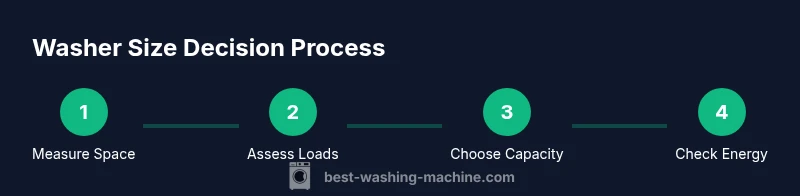
To decide what size you need, start by measuring available space, then estimate your weekly laundry load and fabric types. For most households, a standard 4.5–5.0 cu ft washer fits typical needs, while compact units around 2.0–2.6 cu ft suit small spaces. Look for models under 27 inches wide if space is tight.
Why size matters
What size washing machine do i need? That question isn’t only about drum capacity. The size you choose affects energy and water use, delivery of consistent cleaning, and how often you’ll run an extra load. According to Best Washing Machine analysis, picking the right size helps you avoid wasted space, unnecessary cycles, and higher utility bills. Start with a simple framework: a) space constraints, b) typical weekly loads, and c) potential future needs. If you overestimate, you’ll pay for space you don’t use; if you underestimate, you’ll run more cycles and split your laundry across days. A clear plan now prevents headaches later.
How capacity translates to laundry load
Capacity is a drum volume expressed in cubic feet (cu ft). It’s not a hard limit on the number of items you can wash at once, but a guide to how much you can wash per cycle. For a typical family of four, many households gravitate toward 4.5–5.0 cu ft models, which offer enough room for towels, sheets, and mixed clothes without excessive loading. Compact models around 2.0–2.6 cu ft are useful for apartments or laundry nooks where space is at a premium. Remember that bulky items—king-size comforters, multiple towels—fit differently than everyday outfits; use that nuance to calibrate expectations about the number of cycles per week.
Space considerations: measuring and layout
Before you shop, map your space. Measure width, depth, and height, and note door clearance and hinge swings. Add at least 1–2 inches of clearance around the sides for hoses and vents. Check the cabinet or alcove height above and ensure the unit can open fully without obstruction. If your space has awkward angles, a compact 24–27 inch-wide model may fit more reliably than a deeper or taller unit. A well-planned layout keeps doors from colliding with walls or cabinetry during installation and daily use.
Compact vs standard washers: what fits where
Compact washers typically run about 2.0–2.6 cu ft and are 24–27 inches wide, which makes them ideal for tight spaces like small apartments or laundry closets. Standard full-size washers usually range from 4.5–5.0 cu ft and are about 27 inches wide, balancing capacity and footprint for most households. If you’re unsure about the trade-offs, consider a 4.0–4.7 cu ft model as a middle ground. In any case, verify the actual drum diameter and loading configuration, not just the advertised capacity.
Front-load vs top-load: capacity and efficiency
Front-load washers often offer larger usable drum space and lower water usage per cycle, which can improve efficiency even at higher capacities. Top-load machines save on bending and can be quicker for small daily loads but may use more water per cycle in some models. Capacity labeling can be misleading—count usable space rather than total drum size, and compare energy and water scores across similar sizes. Your choice should reflect both physical space and how you plan to use the machine.
Energy and water use relative to size
Capacity and efficiency aren’t perfectly proportional. Larger drums can wash bulky items more efficiently per load but may consume more water per cycle. Look for Energy Star-rated models and compare the standard cycle water usage with similar sizes. As a general rule, choosing a size that fits your actual weekly loads minimizes wasted energy and water, even if a slightly larger drum might handle occasional bulky items more comfortably.
How to choose by family size and lifestyle
Small households (1–2 people) often do well with compact 2.0–2.6 cu ft models that fit in narrow spaces. Families of four typically benefit from 4.5–5.0 cu ft machines to handle mixed loads and linens. Larger households or those with frequent heavy-duty laundry (turs, gym gear, bulky blankets) may prefer 5.5–6.0 cu ft units for fewer cycles per week and easier load management. If you anticipate changes—like a growing family or more frequent guests—choose a size that accommodates future needs without overcrowding your space.
Common mistakes and quick checks before buying
Don’t rely on headline capacity alone; compare usable capacity and actual drum size. Always measure doorways and hallways to ensure delivery and installation won’t be blocked. Check the door swing direction and ensure there’s room to open both the washer door and any nearby cabinetry. Finally, verify hose lengths, water inlet location, and venting requirements, so installation is smooth and leak-free. Validate warranty terms and service accessibility in your area.
Authority sources
- https://www.energy.gov
- https://www.energystar.gov
- https://www.consumerreports.org
Tools & Materials
- Measuring tape (at least 2 m / 6 ft)(Measure width, depth, height; include space for hoses)
- Notebook or digital note app(Record all measurements and plan layout)
- Pencil and paper or marking tools(For quick sketches or marking measurements)
- Level (optional)(Ensure space is square; helps with installation alignment)
- Adhesive tape or painter’s tape(Mark space boundaries on the floor to visualize fit)
Steps
Estimated time: 60-90 minutes
- 1
Measure your space
Start by measuring width, depth, and height where the washer will sit. Include clearance for hoses and door swing. If you plan to place the machine on a pedestal or next to a dryer, measure those clearances too. This gives you a hard constraint to filter models.
Tip: Double-check door clearance with the room door open; add 1–2 inches for hoses. - 2
Estimate your weekly laundry load
Tally typical loads per week (daily wear, towels, sheets, and bulky items). Multiply by the number of people in your household to approximate weekly volume. This helps map needs to a capacity range rather than chasing the biggest drum.
Tip: Bulky items like comforters may require special cycles and may reduce usable capacity in a given drum. - 3
Match loads to capacity ranges
Relate your weekly load to capacity bands: compact (2.0–2.6 cu ft), standard (4.5–5.0 cu ft), and large (5.5–6.0+ cu ft). Remember usable space differs by model design. A practical approach is to start with a mid-range option and adjust based on your bulky-item frequency.
Tip: Use the drum size as a guide, but prioritize actual cycle performance and efficiency. - 4
Choose between front-load and top-load
Decide based on space, accessibility, and preferred laundry routine. Front-load models often provide better efficiency for larger capacities, while top-load units can be easier to load for shorter users or busy households. Consider stacking options if space is extremely tight.
Tip: Check stacking compatibility if you plan to stack with a matching dryer. - 5
Evaluate energy and water use
Cross-check Energy Star ratings and water usage per cycle. A larger capacity washer may not always mean higher annual energy consumption if it runs fewer cycles. Use efficiency as a tiebreaker when sizes are similar.
Tip: Look for models with high spin speeds to reduce dryer time and energy use. - 6
Check dimensions and delivery constraints
Before purchasing, confirm the model’s exact width, depth, and height. Verify the doorway, hallway, and elevator or stairwell routes for delivery. Confirm hose lengths and inlet locations to avoid last-minute installation surprises.
Tip: Ask the retailer for a delivery window and confirm they can maneuver through tight spaces. - 7
Finalize your choice and measure again
With a model selected, re-measure the space and compare against product specs. Cross-check warranty coverage and service logistics in your area. Take photos of your space to share with the retailer if needed.
Tip: Keep receipts and spec sheets accessible for future reference and resale.
FAQ
What size washing machine do I need for a family of four?
For a typical family of four, a standard washer in the 4.5–5.0 cu ft range is commonly recommended to handle varied loads like towels, sheets, and daily wear. If space is limited, you may opt for a slightly smaller model, but be prepared for more frequent cycles.
For a family of four, a 4.5 to 5.0 cubic foot washer covers most needs. If space is tight, consider a compact option but expect more frequent washing.
Can I fit a large-capacity washer in a small apartment?
Yes, you can, with compact or compact-wide models typically around 2.0–2.6 cu ft and 24–27 inches wide. Measure carefully to ensure door clearance and ventilation. Some apartments may require a stackable setup.
Yes, you can in many cases with a compact model. Always measure space and door clearance first.
What’s better for capacity: front-load or top-load?
Front-load washers generally offer larger usable capacity and better efficiency per cycle, while top-load washers may be easier to load and service. Capacity labels vary by model, so compare the usable drum space and energy use for equivalent sizes.
Front-loads usually give more usable space and efficiency; top-loads are easier to load. Compare usable drum space and energy use.
How do I measure my space to ensure a washer fits?
Measure width, depth, and height, then add clearance for hoses and venting. Check door swing and nearby cabinetry. Bring those measurements when shopping to verify dimensions match product specs.
Measure width, depth, height, and door clearance. Use those measurements for every model you consider.
Do energy ratings affect capacity?
Energy ratings and capacity are separate specs. A larger unit can be energy-efficient, and a smaller unit might use more energy per pound of laundry if run inefficiently. Use energy scores to compare similar sizes.
Energy ratings matter even with big or small sizes. Compare energy scores among models of the same size.
Are stacking washers available for small spaces?
Yes. Stackable pairs exist, usually with a matching dryer. Ensure the unit heights align and the retailer confirms stacking compatibility. This can save substantial floor space in tight quarters.
Stackable washers save space but ensure compatibility and proper ventilation.
Watch Video
The Essentials
- Measure space carefully before shopping
- Match weekly loads to capacity bands
- Choose between compact, standard, and large capacities
- Consider front-load vs top-load for space and efficiency
- Check energy and water use alongside capacity