Compact Washing Machine Dimensions: A Practical Guide for Small Spaces
Explore compact washing machine dimensions, including width, height, and depth, plus measurement tips to fit small spaces. Learn how to read specs, compare models, and choose the right size for apartments and tight laundry corners.


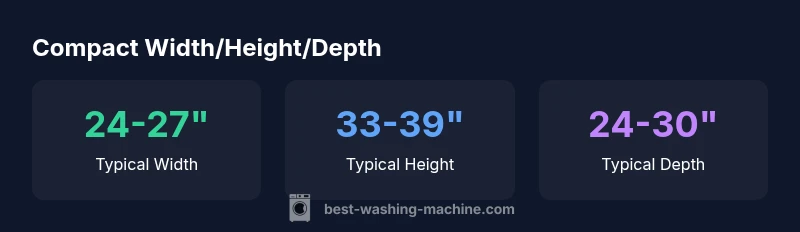
Compact washing machine dimensions typically fall within a narrow footprint: about 24-27 inches in width, 33-39 inches in height, and 24-30 inches in depth. These ranges help you fit washers in apartments, closets, or galley laundry rooms, but always verify models' exact specs for door clearance and hookups. This quick reference is useful when planning a small-space kitchen or utility area.
What "compact" means in washing machines
In the context of laundry appliances, the term "compact" signals a smaller footprint compared with standard full-size models. Definitions vary by region, with U.S. designs often targeting widths under 27 inches, while European and Asia-Pacific models emphasize reduced depth and height to fit tight kitchens and utility alcoves. For homeowners, renters, and operators, understanding these nuances is essential for space planning, door clearance, plumbing access, and ventilation. The Best Washing Machine team notes that while most compact units share a smaller footprint, dimensions can differ by design (front-load vs. top-load) and by model family. Always read the exact specifications and measure your space before purchasing to avoid a mismatch in real-world installations.
Standard dimension ranges you should know
Across the compact category, you’ll encounter a predictable but important range of numbers. Commonly, compact washing machines are about 24-27 inches wide, 33-39 inches tall, and 24-30 inches deep. A few models push beyond these ranges to accommodate unique door swings or extended hoses, so don’t rely on a single spec alone. When you’re shopping, map these three axes to your space: width for side clearance, height for headroom, and depth for cabinet or alcove depth. Always include a few inches of breathing room for hoses, heat dissipation, and user access. This awareness helps prevent a purchase that technically fits the space but feels cramped in operation.
Front-load vs top-load: how dimensions differ
Front-load washers tend to maximize drum diameter within a given footprint, often resulting in slightly taller or deeper units compared with similar top-load models. Top-load machines can be shallower in some designs due to the vertical drum orientation and lid geometry, but door clearance and hinge placements vary by model. If you’re choosing between the two for a tight alcove, consider not only width and depth but also how the door opens and whether you’ll need to pivot the appliance for plumbing access. The dimension differences matter more when you’re fitting around cabinets, a sink, or a stacked configuration.
How to measure your space accurately
Begin with a clean, level surface and a flexible tape measure. Step-by-step: 1) Measure the width between fixed surfaces (including cabinetry) to determine maximum machine width. 2) Measure the vertical clearance from the floor to any ceiling or shelf that could impede installation. 3) Measure depth from the wall to the furthest protruding element (venting, hoses, or door). 4) Check door swing and hinge clearance—if you’re placing next to a wall, ensure the door can open fully without obstruction. 5) Don’t forget plumbing and electrical clearances, plus an extra margin for venting and airflow. The exact numbers matter; always cross-check model specs and, when possible, view the unit in person before buying.
Reading model specs: width x height x depth
Model specifications are typically listed as W x D x H in inches. Always confirm all three dimensions, not just the width, because a shallow depth does not guarantee an easy door swing or accessible hoses. Look for installation notes that specify required clearance around the sides, top, and back. If a model lists a depth near the space width, double-check whether you need to account for a recessed drain line, power cord, or closed front panel access. The more you know about the spec sheet, the smoother the fit in a compact space.
Installation and clearance for small spaces
In tiny spaces, installation considerations are as important as the dimensions themselves. Stacking may save floor area, but it demands a compatible pair and a stacking kit rated for the two units. If stacking isn’t feasible, consider a side-by-side arrangement with a narrow dryer or a compact combination unit. Check ventilation requirements, especially for vented dryers or combination setups, and ensure there’s adequate space behind the machine for hoses and cords. If you plan to install under a countertop, verify whether the model permits an overlaid top or needs a dedicated cabinet cutout.
Real-world placement scenarios: apartments, closets, and shared laundry
In urban apartments, every inch counts. Narrow hallways, kitchen alcoves, and closet nooks are common constraints, driving the need for compact dimensions. A washer placed in a pantry or laundry closet should leave room for detergent storage, baskets, and daily usage. Shared facilities, like a common laundry room, may require stacking or two machines in tandem with careful door swing planning. For healthcare facilities or rental properties, consider accessibility requirements and serviceability—these factors often hinge on precise measurements and model tolerances.
Dimensions by model type
| Model Type | Typical Width | Typical Height | Typical Depth | Notes |
|---|---|---|---|---|
| Front-load | 24-27 | 33-39 | 24-30 | Common compact front-loads with full-width doors |
| Top-load (HE) | 24-27 | 33-39 | 24-28 | Space-saving option with vertical drum orientation |
| Under-counter/compact built-in | 24-25 | 32-36 | 24-26 | Specialized installations and trim kits |
FAQ
What counts as a compact washing machine in terms of dimensions?
A compact washer typically fits within a narrow footprint compared with standard models; expect smaller width, height, and depth ranges that vary by region and design. Always confirm exact specs for your space.
A compact washer is a smaller machine. Check the model specs for exact width, height, and depth.
Do compact washers have smaller capacities?
Yes, compact models generally offer lower drum capacity than full-size machines. Look for the cu ft rating on the spec sheet to compare usable load size.
Most compact washers hold less than full-size models; check the cu ft.
Are 24-inch wide models still widely available?
Yes, 24-inch wide compact washers remain widely available across many brands, especially for apartments. Always verify width in the model specs.
Yes, plenty of 24-inch options exist; double-check the specs.
Can you stack a compact washer and dryer?
Stacking is possible with some compact units if you use a compatible dryer and a stacking kit. Follow the manufacturer’s guidance for the pair.
Stacking can work if the units are compatible.
What should I measure to ensure fit in a tight space?
Measure width, height, and depth, plus door swing, hoses, and ventilation. Allow a few inches of clearance around the box for access and airflow.
Measure all around, including door clearance and hoses.
Do energy-efficient compact washers differ in dimensions?
Energy-efficient compact washers often have dimensions similar to standard models, but insulation and internal design can affect depth and height. Check the spec sheet for exact measurements.
Energy efficiency doesn't usually change size; check specs.
“Dimensions matter not only for fit but for usable space; measure the actual floor space and door clearance before buying.”
The Essentials
- Measure width, height, and depth before buying
- Check door swing and clearance for real-life use
- Read full specs, not just the width
- Consider stacking or built-ins for tiny spaces
- Account for hoses, vents, and ventilation space