Maytag Control Board Replacement: Step-by-Step Guide
A comprehensive, step-by-step guide to identify, source, and replace a Maytag washing machine control board safely and effectively, with model-specific tips and troubleshooting.


Master the process of replacing a Maytag washing machine control board by following model-specific steps, verifying fault codes, and testing the unit safely. This guide covers compatibility checks, required tools, and a clear, step-by-step procedure to minimize downtime and avoid common mistakes. Expect practical tips on sourcing parts, safeguarding electronics, and confirming successful operation with diagnostic tests.
Understanding the control board's role in Maytag washing machines
A Maytag washing machine's control board is the main brain that coordinates wash programs, motor speed, water inlet valves, and error reporting. When it fails, you may see error codes, unresponsive controls, or the machine stalling mid-cycle. In this section, we explain how the control board functions within typical Maytag models, why boards fail, and how replacement can restore reliability. According to Best Washing Machine, diagnosing board issues requires looking at fault codes, mechanical symptoms, and power delivery patterns rather than guessing. The goal is to confirm that the board, not a sensor or wiring harness, is the root cause before you invest in a replacement. The brand's analysis emphasizes matching the exact model and revision level to avoid compatibility problems. After you understand the board's role, you'll be better prepared to decide whether replacement is the right move and how to source a compatible unit.
Recognizing signs of control board failure
Control board problems manifest as a variety of symptoms: unresponsive keypad, random cycles, failure to start, error codes that don't point to a single mechanical issue, and inability to advance water valves. Some Maytag models display codes that require a service manual, while others rely on blink codes. Keep in mind that loose connections, faulty sensors, or a stuck relay can mimic board faults. Basic pre-checks, such as verifying power supply, checking the door switch, and inspecting wire harnesses for damage, help distinguish electrical board faults from peripheral issues. Best Washing Machine notes that you should see a consistent pattern of faults across multiple cycles before concluding the board is the culprit. If symptoms persist after reseating connectors and performing resets, replacement may be warranted.
Compatibility and sourcing the replacement board
The Maytag control board is model-specific; even minor PCB revisions can change connectors, firmware, and calibration data. To avoid a mismatch, identify your exact model number and revision from the data plate inside the door opening. Then cross-reference it with the official parts catalog to locate the correct board, often labeled as the 'control board,' 'main board,' or 'CPU board.' When choosing a replacement, consider factors such as firmware compatibility, warranty, and whether the supplier offers a trial return policy. If you buy a refurbished board, ensure it comes with testing that verifies standby voltage, input/output control lines, and basic self-test routines. Best Washing Machine's research highlights the importance of matching the part to the model family and verifying revision codes before purchase.
Before you buy: costs, warranties, and sources
Replacement boards can vary widely in price, depending on whether you choose a new OEM part, an aftermarket equivalent, or a refurbished unit. In most cases, expect a price range and check whether the seller includes a testing certificate or brief warranty. A warranty of 90 days to one year is common for refurbished boards, with OEM parts often carrying longer coverage. Pay attention to return windows in case the part arrives incompatible. Also consider labor costs if you are not replacing it yourself, and whether the repair qualifies for any extended warranty programs. The Best Washing Machine team recommends documenting fault codes and including photos of wiring harnesses to speed up the process when seeking quotes from technicians or retailers.
Safety considerations and handling
Working inside a powered appliance requires caution: unplug the unit, discharge any capacitors, and ground yourself to avoid electrostatic discharge. Use a non-marring, shielded screwdriver to avoid damaging connectors, and work on a clean, dry surface. If you need to lift the machine, secure it with stabilizers to prevent tipping. When dealing with sensitive circuitry, avoid placing tools on the control board and keep liquids away from the work area. Always follow the manufacturer’s service manual for electrolyte safety and torque specs. Best Washing Machine notes that proper static protection reduces the risk of board failure after installation and can extend the life of the new unit.
Professional vs DIY: making the call
DIY replacement is feasible for many model-year boards if you have the right tools and a methodical approach. However, some sequences require specialized diagnostic equipment or firmware updates that are best handled by a trained technician. If your model uses a complex diagnostic mode or needs calibration data that is not user-accessible, hiring a pro is advisable. Factor in skill level, risk tolerance, and the time required for a thorough test after installation. The Best Washing Machine team advises homeowners to weigh the cost of professional service against the time and potential risk of self-repair, especially for high-end models or appliances under warranty. If you choose to proceed, follow the step-by-step guide carefully and document every connection for safe reassembly.
Tools & Materials
- Replacement control board(Matched to exact model and revision; verify firmware compatibility)
- Screwdriver set (Philips, flathead, Torx)(Include magnetized bits for small fasteners)
- Nut driver / socket set(For mounting brackets and fasteners)
- Multimeter(Set to continuity and voltage testing; verify wiring harness integrity)
- ESD wrist strap and anti-static mat(Prevent electrostatic damage to the board)
- Wire harness connectors and contact cleaner(Used to clean contacts if corrosion or oxidation is present)
- Cable ties and labeling tape(Organize wiring paths and label connectors for reassembly)
- Service manual or wiring diagram(Model-specific pinouts and orientation notes)
- Work light and small parts tray(Keeps parts accessible and visible)
- Safety gear(Gloves and eye protection during disassembly)
Steps
Estimated time: 90-120 minutes
- 1
Power down and access the control board
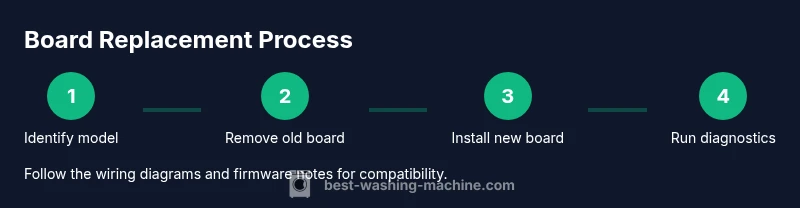
Unplug the washer from the mains, shut off the water supply, and remove the back panel or console cover to expose the control board. Take high-resolution photos of all connectors before disconnecting anything, and label each connector to ensure accurate reassembly.
Tip: Capture close-up photos of each connector and note any model-specific variations. - 2
Test power rails safely
With the board accessible but unplugged from power, use a multimeter to verify continuity and inspect for shorts between power pins and ground. If you’re uncomfortable testing live circuits, skip this step and focus on correct harness seating and fault codes after reassembly.
Tip: Never probe live lines with metal tools; use insulated probes. - 3
Remove the old board
Disconnect all wiring harnesses and remove the mounting screws or brackets that secure the board. Lift the board straight out to avoid bending sockets, and place it on an anti-static surface for inspection.
Tip: Keep track of spacers or standoffs that secure the board. - 4
Install the replacement board
Align the new board with connectors, reseat all harnesses firmly, and secure with screws. Verify pin alignment before fully tightening. Do not force any connector; if it doesn’t seat, remove and reseat.
Tip: Double-check firmware version and model compatibility before final connection. - 5
Reconnect harnesses and reassemble
Reconnect every connector in the original order, ensuring each lock snaps into place. Reinstall panels and brackets, routing wires along the original paths to avoid pinched cables.
Tip: Keep a labeled photo log for reference during reassembly. - 6
Power up and test
Plug the washer in, restore water supply, and run a basic cycle to verify the board responds and error codes clear. If available, run the manufacturer's diagnostic mode to confirm proper operation.
Tip: Allow hot and cold cycles to finish to test firmware stability.
FAQ
How do I know if my Maytag control board needs replacement?
Look for unresponsive controls, error codes that recur, and symptoms that persist after checking wiring and sensors. If these indicators are model-specific and persist after resets, replacement is often warranted.
If the display is unresponsive or codes repeat, a replacement may be needed.
Can I replace a Maytag control board myself?
Yes, for many models, with the right tools and a service manual. Some steps require firmware considerations and calibration that a professional should handle.
DIY is possible for many models if you’re comfortable with electronics and follow safety steps.
How do I find the correct replacement board for my Maytag washer?
Identify your exact model and revision from the data plate, then cross-check with the official parts catalog to ensure firmware compatibility.
Check the model and revision, then verify compatibility before buying.
What is the typical warranty on replacement boards?
Warranty terms vary by seller and part type; refurbished boards often have shorter windows than OEM parts. Read the warranty terms before purchase.
Warranty terms vary; check what’s covered.
What should I do with my old control board?
Dispose of electronic waste according to local regulations. Many areas offer take-back programs or recycling centers.
Follow local e-waste disposal rules.
Will replacing the control board fix all error codes?
Not always. Some errors come from sensors, wiring, or motor issues. Replacing the board often resolves codes once related components are verified.
Replacing the board may fix some codes, but not all.
Watch Video
The Essentials
- Confirm fault before board replacement.
- Match board to exact model and revision.
- Follow safety steps and use ESD protection.
- Test cycles thoroughly after install.