OE Fault Code LG Washing Machine: Urgent Drain Fix Guide
A focused guide to diagnose and fix the OE drain code on LG washing machines, featuring fast home diagnostics, common causes, step-by-step repairs, safety tips, and cost ranges.


OE fault code on an LG washing machine signals a drainage problem. The washer isn't draining within the expected time. Quick fixes: check that the drain hose isn't kinked or blocked, clean the pump filter, ensure the drain pump is powered, and run a spin/drain cycle. If the code persists, you may need a service call. Best Washing Machine recommends starting with these easy steps.
What OE Means for LG Washing Machines
When the OE code appears on an LG washer, it signals a drainage fault that prevents the machine from completing the cycle. The OE message is a warning that water cannot be evacuated in time, and the drum may still be full. In practice, OE often comes from a blocked drain path: a clogged pump filter, a kinked or blocked drain hose, or a pump that isn’t switching on. Because proper drainage is essential to every cycle, the machine halts and alerts you with OE. According to Best Washing Machine, the majority of OE incidents are resolved by addressing the drain path and filter first. The phrase oe fault code lg washing machine is common in guides because this is almost always a drainage issue rather than a random sensor fault. Acting quickly reduces water damage and wear on surrounding components. In 2026 our analysis of LG models shows that routine maintenance and quick checks prevent reoccurrence for many households.
Quick Home Diagnostics for OE
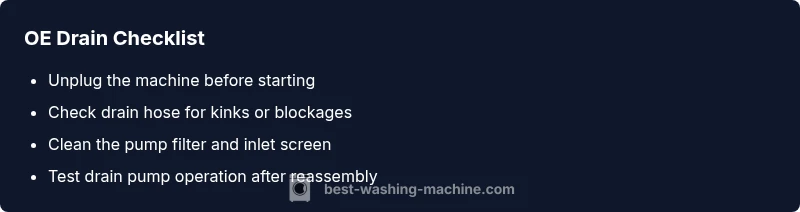
Before calling a repair tech, try these at-home checks to confirm a drainage issue is active. Start by unplugging the machine and moving it to a safe area. Inspect the drain hose for kinks, twists, or clogs; ensure the hose is not elevated too high or pressed against sharp edges. Access the pump filter (usually behind a small door at the bottom front) and clean out lint and debris. Reassemble, run a drain or empty cycle, and listen for a smooth flow of water. If water fails to drain or the OE code reappears, note any error lights or beeps and prepare to test the pump’s power using a multimeter or by checking the door switch and wiring.
Common Causes of OE (Drain-Related)
- High likelihood: Clogged pump filter, kinked or blocked drain hose, and a blocked drain pump impeller
- Medium likelihood: Faulty drain pump or worn impeller, insufficient water level sensor function, or a partially blocked drain path
- Low likelihood: Control board issues or sensor faults that misreport drainage status
Based on Best Washing Machine analysis, most OE codes are resolved by cleaning the filter and clearing the drain path. If the pump runs but water doesn’t move, the issue often lies with the pump itself or its wiring.
Safety First: When to Call a Professional
If any step reveals damaged hoses, exposed wiring, or signs of water damage, stop immediately and contact a licensed technician. Working near live components can shock or short the machine; use insulated gloves and disconnect power at the outlet. Do not attempt to bypass safety features or replace a pump without proper testing and the right parts. If the OE code persists after the basic drain path checks, a professional repair typically involves drain pump replacement or wiring repairs and can cost more. Best Washing Machine recommends obtaining an upfront estimate and confirming warranty coverage if applicable.
What to Expect After a Fix: Costs and Timelines
Most simple drain fixes done by homeowners are inexpensive, often requiring only a few dollars for filter replacements or a cleared hose, but professional service for an OE drain fault usually falls in the range of $100-$400, depending on parts and labor. If the pump must be replaced, costs can rise to $200-$500 including labor. If the control board or sensor needs replacement, you could be looking at $350-$800 for parts and service. The timeline for repairs often ranges from 1-3 hours for quick fixes to a half-day for parts replacement or testing. After a successful fix, run a test cycle to ensure drainage is complete and that OE does not reappear.
Steps
Estimated time: 30-45 minutes
- 1
Power down and prepare
Unplug the washer, move it to a safe area, and gather towels and a shallow tray. This keeps you safe and helps manage any residual water.
Tip: Have a container ready to catch draining water and a flashlight for tight spaces. - 2
Access the drain filter
Open the lower front panel or toe-kick access door to locate the drain filter. Place a towel under the area to catch any leaks, then slowly remove the filter housing.
Tip: Take note of the filter orientation so you reinstall it correctly. - 3
Clean the drain filter
Remove all debris from the filter and rinse under running water. Reinsert the filter with a snug seal to prevent leaks.
Tip: Inspect the area around the filter for hidden debris that might fall into the sump. - 4
Check the drain hose for kinks
Trace the drain hose to ensure it isn’t kinked, crushed, or blocked. If possible, disconnect and run water through the hose to test for flow.
Tip: Never bend or crush the hose sharply; keep it straight and secure. - 5
Test the drain pump
With power off, inspect visible wiring to the pump. If you have a multimeter, test for continuity or have a professional test the pump if you’re unsure.
Tip: Do not run the pump when it’s disconnected from the harness; risk of shock remains. - 6
Run a drain cycle
Plug back in, run a drain/empty cycle, and listen for a steady flow of water exiting the drum. Observe for any error codes or leaks.
Tip: If water doesn’t drain, stop the cycle and recheck all connections before proceeding. - 7
Assess results and next steps
If OE persists, document the evidence (codes, noises, water levels) and plan for pump repair or replacement, or consider professional service.
Tip: Keep the model number and serial handy for accurate parts quotes.
Diagnosis: OE error code displayed, washer won't drain
Possible Causes
- highBlocked drain filter
- highDrain hose kink or blockage
- mediumDrain pump failure
Fixes
- easyClean the drain filter
- easyUn-kink or clear the drain hose
- hardTest or replace the drain pump
FAQ
What does OE mean on LG washing machines?
OE is a drainage fault indicating water can't drain properly. It usually points to the drain path, filter, or pump. If the code won't clear after basic checks, professional service may be required.
OE on LG washers is a drainage fault. Start with the drain path and filter, and consider a pro if it persists.
How can I reset the OE code on my LG washer?
Power cycle the machine: unplug for 3-5 minutes or switch off the circuit, then plug back in and restart. If the drain is clear, the code may clear, but monitor for a repeat cycle.
Try a simple power cycle and restart, then watch for the OE code again.
Can a clogged filter cause OE?
Yes, a clogged drain filter is a common cause of OE. Cleaning the filter often resolves the error and restores proper drainage.
A clogged filter often triggers OE; cleaning it is the first fix.
Should I call a professional for OE?
If DIY checks don’t fix OE, especially with a faulty pump or wiring, a pro is recommended. They can safely test components and confirm part replacements.
If it still shows OE after DIY checks, get a professional to diagnose.
How much does it cost to repair OE on LG?
Repair costs vary; expect a range of roughly $100-$400 for drainage-related fixes by a pro, with higher costs if major components like the pump or control board are replaced.
Most repairs for OE fall between $100 and $400 unless a major part is needed.
Is it safe to run the washer with OE?
No. Running with OE can lead to overflow and water damage. Stop and fix the drainage issue before starting another cycle.
Do not run the washer until OE is resolved.
Watch Video
The Essentials
- Unplug before inspection.
- OE = drainage fault; start with hose and filter.
- Most fixes are drain-path related.
- If the code repeats after DIY, call a pro.