Why Is My Washing Machine Overfilling? Troubleshooting Guide
Discover why your washing machine overfills and how to fix it safely. Quick checks, step-by-step guidance, and prevention tips from Best Washing Machine.


Most cases of overfilling a washing machine are caused by a faulty water level sensor or pressure switch, a stuck-in valve, or a blocked pressure hose. Quick fixes include unplugging the machine, shutting off the water supply, and inspecting the pressure hose for kinks or cracks. If the sensor is faulty, you likely need replacement or professional testing.
What happens when a washer overfills
When your washing machine fills beyond the normal level, it can lead to spillover, leaks, and an inability to complete cycles. If you’re asking why is my washing machine overfilling, the root cause is usually a failed signal to stop filling. In many homes the culprit is a faulty water level sensor or pressure switch that doesn’t register the correct tub level. A clogged pressure hose or a sticking inlet valve can also cause continued filling. Electrical faults in the timer or control board may manifest as an overfill when the system does not terminate the fill cycle as designed. By identifying the most likely culprit first, you can avoid unnecessary part replacements and get back to a normal laundry routine quickly.
How to safely approach the problem
Before you start any inspection, power down the machine and disconnect it from the outlet. If you’re dealing with a high water level, shut off the water supply to prevent more water from entering. Wear gloves and use towels to manage potential spills. Work in a dry area and keep children and pets away while you inspect internal components. Remember: water and electricity don’t mix, so safety is your top priority.
Steps
Estimated time: 60-90 minutes
- 1
Power down and unplug
Unplug the machine from the outlet and turn off the household power. If the unit is hard to reach, switch off the circuit breaker for extra safety. This prevents any risk of electric shock while you work.
Tip: Have a dry towel handy; you may catch some residual moisture when opening panels. - 2
Shut off water supply
Close both hot and cold water faucets to stop new water from entering the machine. This reduces overflow risk while you inspect hoses and valves.
Tip: Lead with the hose that feeds the tub; check both lines for pressure and condition. - 3
Inspect the drain and pressure hose
Access the back panel or tub area to locate the pressure hose connecting the tub to the pressure switch. Look for kinks, cracks, or loose clamps that could trigger incorrect readings.
Tip: Do not tug hard on hoses; a gentle wiggle can reveal looseness without causing damage. - 4
Test the pressure switch
With the machine unplugged, locate the pressure switch and trace the tubing. If you have a test button or a multimeter, follow the service manual to verify switch continuity and response to pressure.
Tip: Refer to your model’s service guide for correct resistance values and testing procedure. - 5
Check the inlet valve
Reconnect water supply and observe whether water continues to flow after you pause or remove power. A valve that sticks open can cause continuous fill even with the sensor functioning.
Tip: If you see constant flow despite power removal, the valve is the likely culprit and should be replaced. - 6
Reset or recalibrate control components
Some brands offer a service mode to reset sensors or recalibrate the pressure switch. If you can access this feature, perform the reset following the manual.
Tip: Only use official steps; improper resets can worsen the issue. - 7
Test run on a small load
After reassembly, run a short wash with a minimal load to observe whether the tub fills correctly and shuts off at the appropriate level.
Tip: Do not load heavily until you’re confident the issue is resolved. - 8
Call a professional if unresolved
If the washer still overfills after these checks, a qualified technician should diagnose wiring faults, sensor failure, or control-board issues.
Tip: Note any error codes and symptoms to share with the technician.
Diagnosis: Washer overfills during fill cycle or entire wash
Possible Causes
- highFaulty water level sensor or pressure switch
- mediumBlocked or kinked pressure hose
- mediumStuck/inlet valve allowing continuous water flow
- lowControl board or timer fault not terminating fill
Fixes
- easyInspect pressure hose for kinks or disconnections and reseat connections
- mediumTest the water level sensor/pressure switch according to model instructions and replace if faulty
- mediumCheck the inlet valve for leaks or sticking; replace if water continues to flow after shutoff
- hardRun diagnostic codes on the control board or replace faulty module if cycle doesn’t stop
FAQ
What is the most common cause of washing machine overfilling?
The most common cause is a faulty water level sensor or pressure switch that fails to signal when to stop filling. A damaged pressure hose or a sticking inlet valve can also trigger overfilling.
The most common cause is a faulty water level sensor or pressure switch, often with a damaged hose or sticking valve as a close second.
Can a clogged pressure hose cause overfilling?
Yes. If the pressure hose is clogged or kinked, the sensor may not read tub water level correctly, causing the washer to fill too much.
Yes. A clogged or kinked pressure hose can lead to overfilling by giving a false tub level reading.
Is it safe to run the washer if it’s overfilling?
No. Overfilling can overflow and damage surroundings. Unplug, shut off water, and check the sensor or valve before testing again.
No. Don’t run it until you check the sensor and valves; unplug first.
Will a sensor replacement fix the issue?
Replacing a faulty water level sensor or pressure switch typically resolves overfill when the cause is sensor-related. A professional can confirm compatibility with your model.
Replacing the sensor often fixes sensor-related overfill after confirmation.
When should I replace the whole unit instead of repairing?
If multiple control components fail or the cabinet shows signs of water damage, replacement may be more cost-effective than ongoing repairs. A technician can help assess.
If several parts fail or there’s water damage, replacing the unit may be best.
What maintenance prevents overfilling?
Regularly inspect hoses and seals, keep filters clean, and perform periodic sensor checks per the user manual to catch issues before they cause overfill.
Do periodic sensor checks and hose inspections to prevent overfill.
Watch Video
The Essentials
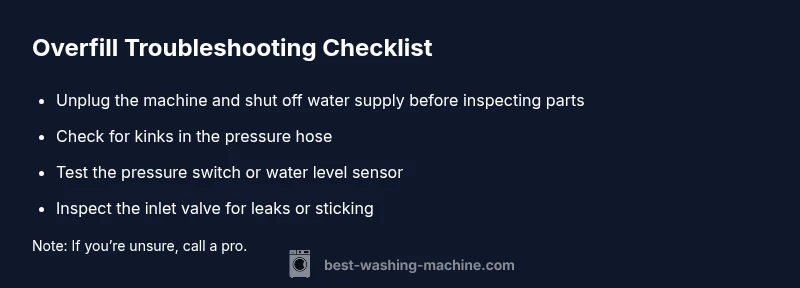
- Unplug and shut off water before inspection
- Sensor and pressure switch are the most common culprits
- Inspect hoses and inlet valve for faults
- If unresolved, professional service is recommended