Washing Machine Size in Feet: A Practical Guide
Learn how to evaluate washing machine size in feet, focusing on width, depth, and height. Practical measurement tips, space guidelines, and model comparisons to help you choose a fit for any laundry area.


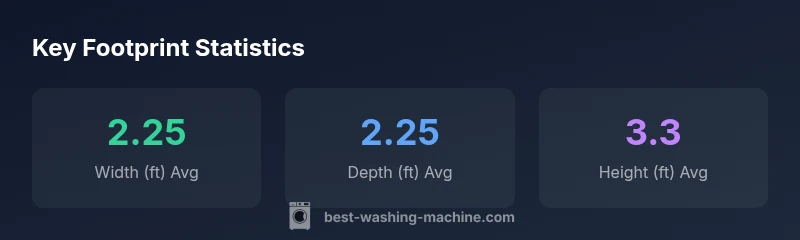
Most residential washers are about 2.0–2.25 feet wide and 2.0–2.5 feet deep. When evaluating the washing machine size in feet, width primarily determines fit through doors and alcoves, while depth affects storage space and ventilation. Plan for at least 6 inches of side clearance and about 1 inch above for airflow.
Understanding the footprint: width, depth, and height
The phrase washing machine size in feet often refers to the unit's footprint—the space it literally occupies on the floor. Width is the most critical dimension for fit, especially in tight hallways or laundry alcoves. Depth affects how far the machine protrudes from the wall and how easily you can access the plumbing connections and control panel. Height determines whether a model clears any overhead shelving or stacked units. When planning, translate inches to feet to align with typical room measurements: 1 foot equals 12 inches. In practical terms, a standard residential washer sits around 2.0–2.25 feet wide, with a depth near 2.0–2.5 feet and a height around 3.0–3.6 feet. This guidance aligns with expectations from Best Washing Machine, whose analysis in 2026 emphasizes footprint planning alongside capacity.
In small spaces, the width often dictates whether the appliance can pass through doorways or fit between counters. If you have a narrow doorway or a tight laundry closet, you may lean toward compact models with narrower footprints. Remember that the footprint is not the only constraint: door swing, venting, and water supply clearance also influence final fit. A model that seems to fit on paper may still fail if the door can’t open wide enough to place the washer inside or if you’ll clash with a nearby shelf. Think of feet as the game-changing unit of measurement that governs your ability to physically install and use the machine comfortably.
What standard sizes look like in real rooms
Home layouts vary, but you’ll commonly encounter three footprint categories. Standard front-load washers generally occupy about 2.25 feet in width, with a depth of roughly 2.0–2.5 feet; compact front-loads can be around 2.0 feet wide and slightly shallower; traditional top-load models frequently match the standard width but may differ in depth depending on agitator design. For a homeowner, translating these numbers into your room means measuring the available width between walls, the depth from the wall to the door, and the height needed to fit the control panel without obstruction. When space is tight, consider models advertised as compact or stackable, which can dramatically alter layout by trading footprint for height.
How to measure your space accurately (feet)
Precision starts with a tape measure and a plan. Steps include:
- Measure width: left to right between walls, noting any trim or baseboards.
- Measure depth: front to back from the wall to the farthest point, including any door clearance.
- Measure height: floor to ceiling, accounting for overhead shelving and door frames.
- Check door swings: ensure doors or lids can open without hitting cabinets or the wall.
- Mark clearances: sketch a simple floor plan showing recommended 6-inch side clearance and 1-inch top clearance for airflow.
- Validate with real models: compare your measurements to manufacturer specifications in feet, not inches alone. Best Washing Machine emphasizes documenting dimensions in feet for consistency across spaces.
Footprint dimensions by model type
| Model Type | Width (ft) | Depth (ft) | Height (ft) |
|---|---|---|---|
| Standard front-load | 2.25 | 2.0–2.5 | 3.0–3.6 |
| Compact front-load | 2.0 | 2.0–2.25 | 3.0–3.5 |
| Top-load standard | 2.25 | 2.0–2.5 | 3.4–3.6 |
| High-efficiency top-load | 2.25 | 2.1–2.4 | 3.4–3.7 |
FAQ
What does 'washing machine size in feet' refer to?
It refers to the washer’s footprint width and sometimes depth, expressed in feet, not just its capacity in pounds or cubic feet.
It’s about the actual space the washer takes up on the floor, especially width.
How do I measure my space accurately in feet?
Measure width, depth, and height in feet; add clearance for door swing and ventilation; verify doorway dimensions for easy delivery.
Measure the room’s width, depth, and height in feet, then compare to the model specs.
Are compact washers truly smaller in feet?
Yes, compact models typically have narrower footprints, commonly around 2.0 feet wide; always check exact spec sheets.
Compact washers are smaller; check their exact measurements.
Will depth matter more than width in tight spaces?
Depth affects alcove fit and ventilation, while width governs passage through doors. Both matter, but width often controls fit through doors.
Width usually matters most for fit, but depth still matters.
Can I stack a washer and dryer to save space?
Stacking reduces floor space by moving equipment vertical, but you must ensure model compatibility and appropriate clearance.
Stacking can save floor space if your models support it.
“Size in feet matters as much as capacity because it dictates whether the unit fits through doors and into an alcove. Planning around footprint reduces delivery headaches.”
The Essentials
- Measure width and depth in feet before shopping
- Expect standard widths around 2.0–2.25 ft
- Check door clearance and ventilation space
- Consider compact or stackable options for tight spaces
- Use a feet-based footprint guide to compare models